
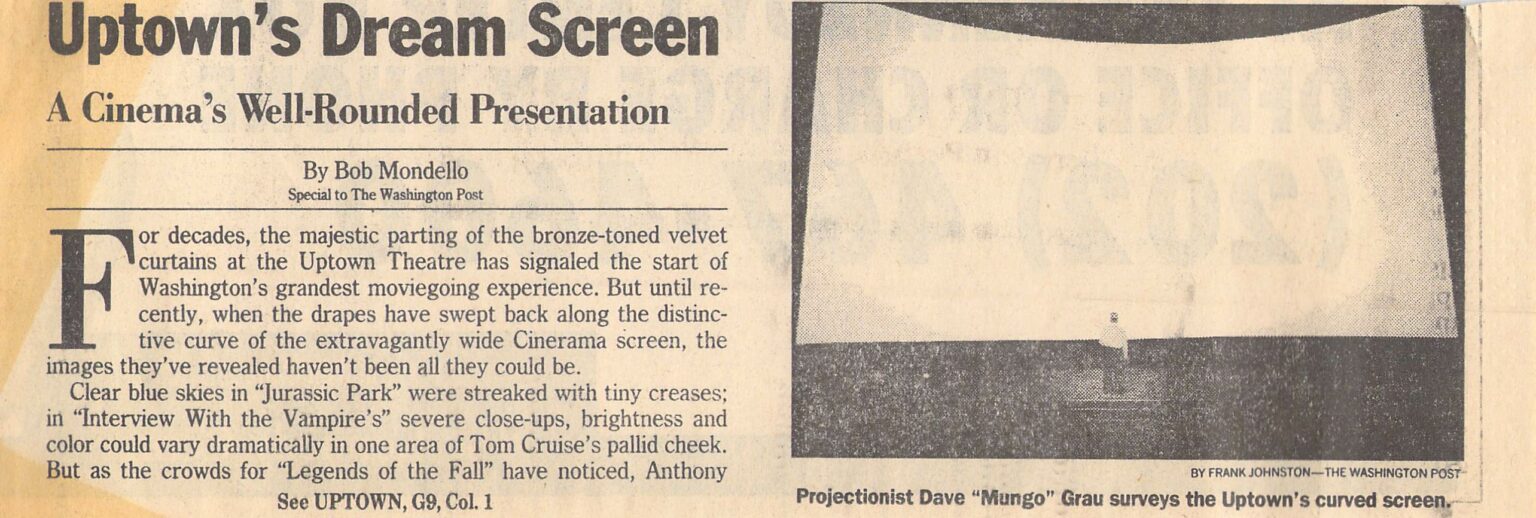
I used to live near DC and went to the Uptown theatre there a lot (sadly, now closed, due to the pandemic). I just came across this clipping I saved while sorting and tossing old papers. It’s from Sunday, January 29, 1995, in The Washington Post, talking about how their old vertical-strip Cinerama screen was replaced with a new single-sheet screen.

Transcript
Uptown’s Dream Screen
A Cinema’s Well-Rounded Presentation
By Bob Mondello
Special to The Washington Post
Sunday, January 29, 1995; pages G1 and G9For decades, the majestic parting of the bronze-toned velvet curtains at the Uptown Theatre has signaled the start of Washington’s grandest moviegoing experience. But until recently, when the drapes have swept back along the distinctive curve of the extravagantly wide Cinerama screen, the images they’ve revealed haven’t been all they could be.
Clear blue skies in "Jurassic Park" were streaked with tiny creases; in "Interview With the Vampire’s" severe close-ups, brightness and color could vary dramatically in one area of Tom Cruise’s pallid cheek. But as the crowds for "Legends of the Fall" have noticed, Anthony Hopkins’s visage now has only the lines nature and makeup artists put there, while Brad Pitt’s baby blues are a uniform shade of cerulean.
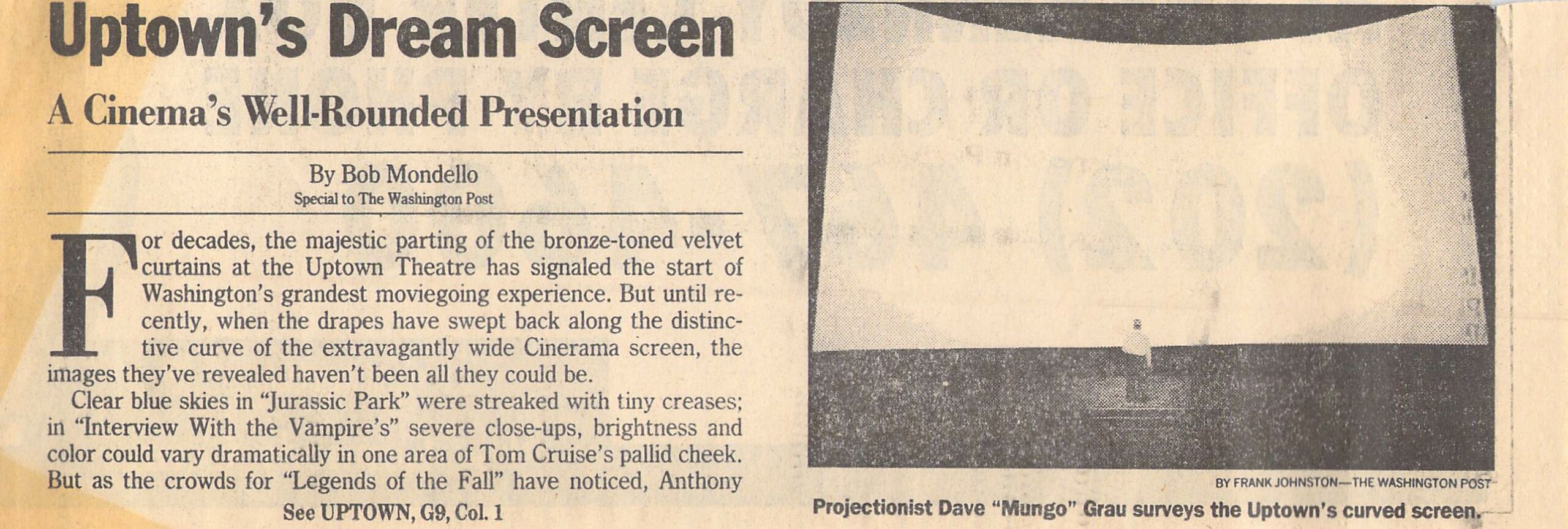
That’s because with no fanfare — unless you count the sigh of relief that emanated from some of the Uptown’s projectionists — the hundreds of spring-mounted, floor-to-ceiling, 1½-inch-wide strips that made up the old screen were replaced earlier this month. The old surface was in essence a deeply curved set of vertical Venetian blinds, some of which had been replaced over the years, causing variations in tone. The new one is a sweeping parabola that Cineplex Odeon spokesmen say is almost exactly the same size as the one audiences have viewed so fondly since the mid-1950s. It is 30 feet high, 70 feet wide and its curve is nearly 20 feet deep.
"For presentation, the Uptown is one of the top three theaters in the country," claims Jim Pedas, who with his brother Ted acquired the faded but still elegant 1,012-seat house from Stanley Warner Theaters in 1978, turning it into the flagship of their Circle Theater chain before selling out 10 years later to Cineplex Odeon. "The screen’s not the only reason, but it has a lot to do with it."
Audiences clearly agree, since the theater almost always produces the highest area grosses for whatever film it plays. Patrons have been willing to overlook the fading grandeur of the auditorium, which wasn’t much helped by the installation of castoff seats from a more modern theater two years ago. But management worried that it was getting hard to overlook the condition of the screen.
"The strips had gotten old, and yellow, and faded," says Cineplex Odeon General Manager Bob Jones. That meant they no longer reflected as much light as they once did. Also, humidity levels affected the cloth from which they were made, with winter dryness making the strips contract slightly, accentuating the lines between them. Clearly they needed to be replaced. And since screen technology has changed over the years, spurred by such innovations as the Imax process used at the Air and Space Museum (where a double-size 65mm image is projected onto a screen almost twice as tall as the Uptown’s), a one-piece screen now seemed a better alternative.
A few questions needed to be resolved about whether the extraordinary depth of the curve — regarded as sacrosanct by generations of area moviegoers who’ve been swept up in Cinerama buffalo stampedes ("How the West Was Won") and SuperPanavision space travel ("2001: A Space Odyssey") — could be maintained in a brighter, one-piece screen. Jones says there was initially "some concern about cross-reflection," in which light bounces from one side of the screen to the other. That turned out not to be a problem. In any event, he says, putting in a flat screen was never seriously considered.
Throwing a Curve
Built to entertain Depression-era crowds in 1936 by the Stanley Warner Theater circuit, the Uptown originally seated close to 1,300 patrons in a broad, balconied arc facing a conventionally squarish screen. Popular through the war years — when admission for servicemen in uniform cost 22 cents — the theater, like thousands of others across the nation, found its audience dwindling after the advent of television. So it made sense for the owners to sacrifice some 200 seats in the mid-’50s to make room for the newfangled, curved, extremely horizontal Cinerama screen that was designed to emphasize what audiences couldn’t get in their living rooms: the sweep and grandeur of Hollywood epics.
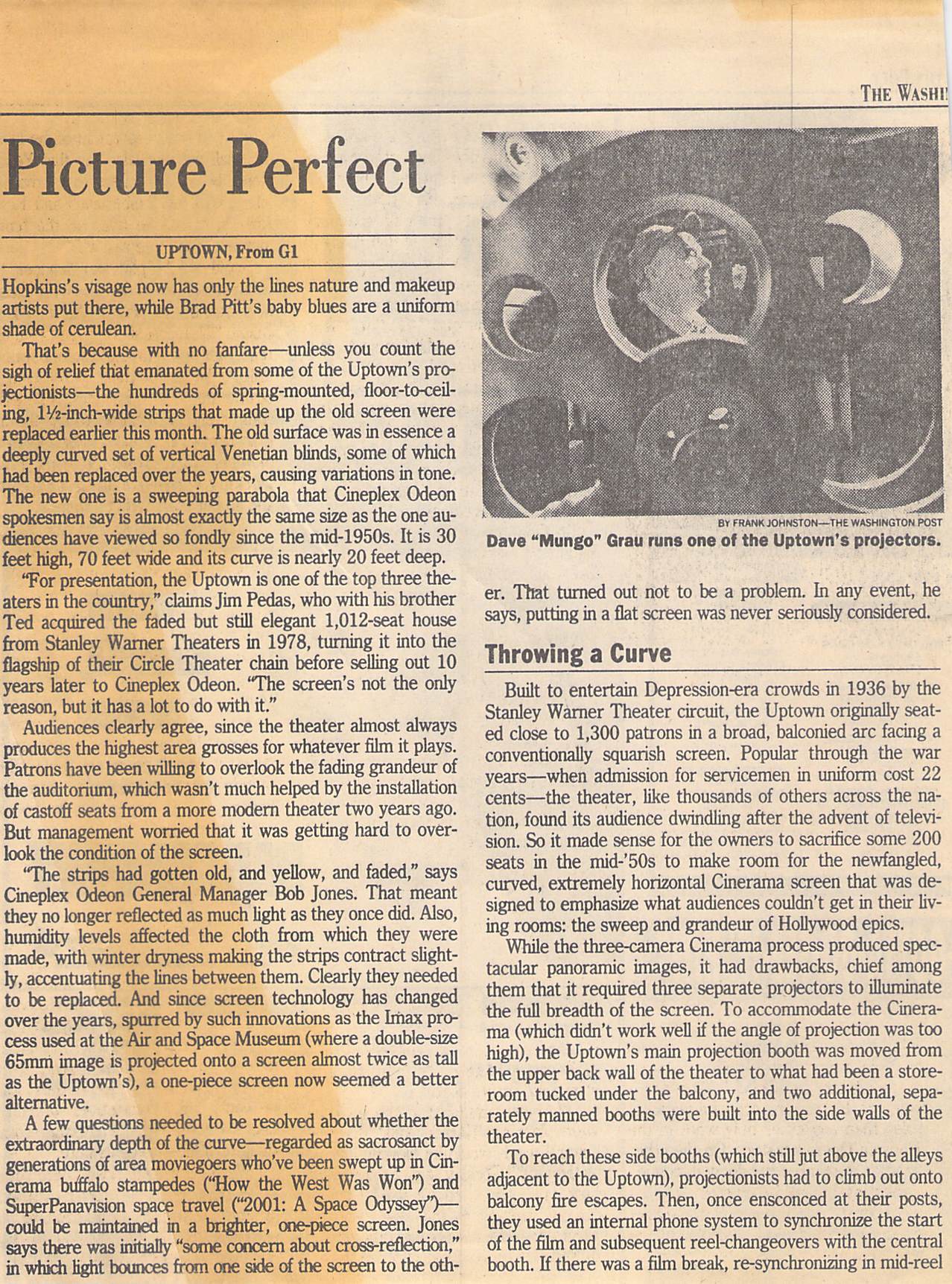
While the three-camera Cinerama process produced spectacular panoramic images, it had drawbacks, chief among them that it required three separate projectors to illuminate the full breadth of the screen. To accommodate the Cinerama (which didn’t work well if the angle of projection was too high), the Uptown’s main projection booth was moved from the upper back wall of the theater to what had been a storeroom tucked under the balcony, and two additional, separately manned booths were built into the side walls of the theater.
To reach these side booths (which still jut above the alleys adjacent to the Uptown), projectionists had to climb out onto balcony fire escapes. Then, once ensconced at their posts, they used an internal phone system to synchronize the start of the film and subsequent reel-changeovers with the central booth. If there was a film break, re-synchronizing in mid-reel was impossible, and they’d just have to let the other two projectors run, leaving a third of the screen dark.
Miraculously, most of the time there was only a slight blurring where the three Cinerama images joined to create one panoramic vista. But the complexity and expense of the process led filmmakers to gravitate to simpler (and less emphatically horizontal) wide-screen formats by the early ’60s. CinemaScope, Panavision and their various 70mm incarnations ended up being the most common, all of them about 15 to 20 percent narrower than Cinerama.
So for the most part, the very farthest reaches of the Uptown’s curve aren’t used by contemporary films. "Legends of the Fall," for all its sweeping western landscapes, is designed to be projected on a normal, squarish screen, and won’t look all that truncated even when it’s reduced to video. Pitt, Hopkins et al. loom large at the Uptown, but their carousing and moping is limited to the center 50 feet of the screen’s 70-foot expanse.
Fond as nostalgic audiences are of the parabolic screen, there are those who think the curve is more trouble than it’s worth. Include among them projectionist Dave Grau (better known as Mungo, a moniker he acquired as Bo Diddley’s drummer). Grau says that after projecting films in all sorts of venues for 38 of his 48 years — having learned the ropes at his father’s Pennsylvania drive-in — he much prefers showing movies on flat screens. "Focusing," he says, "is always a compromise when the screen curves as much as [the Uptown’s] does."
Still, as the guy who was in the booth when the new Uptown screen was installed two weeks ago, Grau has a certain respect for the improvements it brings. "It’s a lot brighter," he says. "And the image is sharper." Also, it’ll never be subject to vagaries of the weather. "Every time the heat went on," he recalls of the old screen, "you’d get this ripple effect" as air from the vents caused hundreds of 30-foot ribbons to vibrate independently.
"I won’t miss that," he says.
Nor will he miss the night he told a friend to meet him in a bar across the street after the last show, only to watch horrified from the booth as a mother allowed her child to run the full breadth of the screen with his finger twanging the strips as if they were harp strings. "I was here till 5 a.m. straightening out those damn slats," Grau grimaces. "Coulda smacked that kid."
Photo captions (both photographs by Frank Johnston — The Washington Post):
- Projectionist Dave "Mungo" Grau surveys the Uptown’s curved screen.
- Dave "Mungo" Grau runs one of the Uptown’s projectors.